Blog updated: Sept. 24, 2026
You've got a laptop, a pair of headphones and maybe forty half-finished projects. What you don't have is any idea whether you're three months or three years from someone actually paying you for this. Ask how to become a music producer and nobody gives you a straight answer, because most of the people answering have something to sell you.
So here's the straight version. There is no licence, no certification and no degree required to become a music producer. What the job takes is a trained ear, DAW fluency, command of signal flow, and enough real sessions behind you that a studio trusts you won't sink theirs. You can build all of it alone, and most people who try take years. Training mostly buys you speed, correction and connections.
A meaningful number quit before they get there.
The Five Things You Actually Have to Learn
Strip away the mythology and the skill set is specific and teachable.
- Train your ear. Hearing that a mix is muddy is the easy part. Hearing why, and knowing which move fixes it, takes hundreds of hours of critical listening. This is the single skill that most separates working producers from talented hobbyists.
- Get fast in Pro Tools. Sessions move at the speed of the room so getting quick on your DAW is important. Hunting through menus while an artist waits is how you stop getting called.
- Understand signal flow. Gain staging, EQ, compression, and how they interact. The physics under the art. Get this wrong and no amount of plugin knowledge saves the take.
- Learn to run a room. Coaching a nervous vocalist through take eleven, or reading that the right move is to say nothing at all, is genuinely half the job.
- Treat it like a business. Invoicing, session files somebody else can open, turning work around when you said you would. The producers who last are the ones who are easy to work with.
Notice that most of these are impossible to practise alone. You cannot learn to run a room without a room.
What the Job Actually Looks Like on a Tuesday
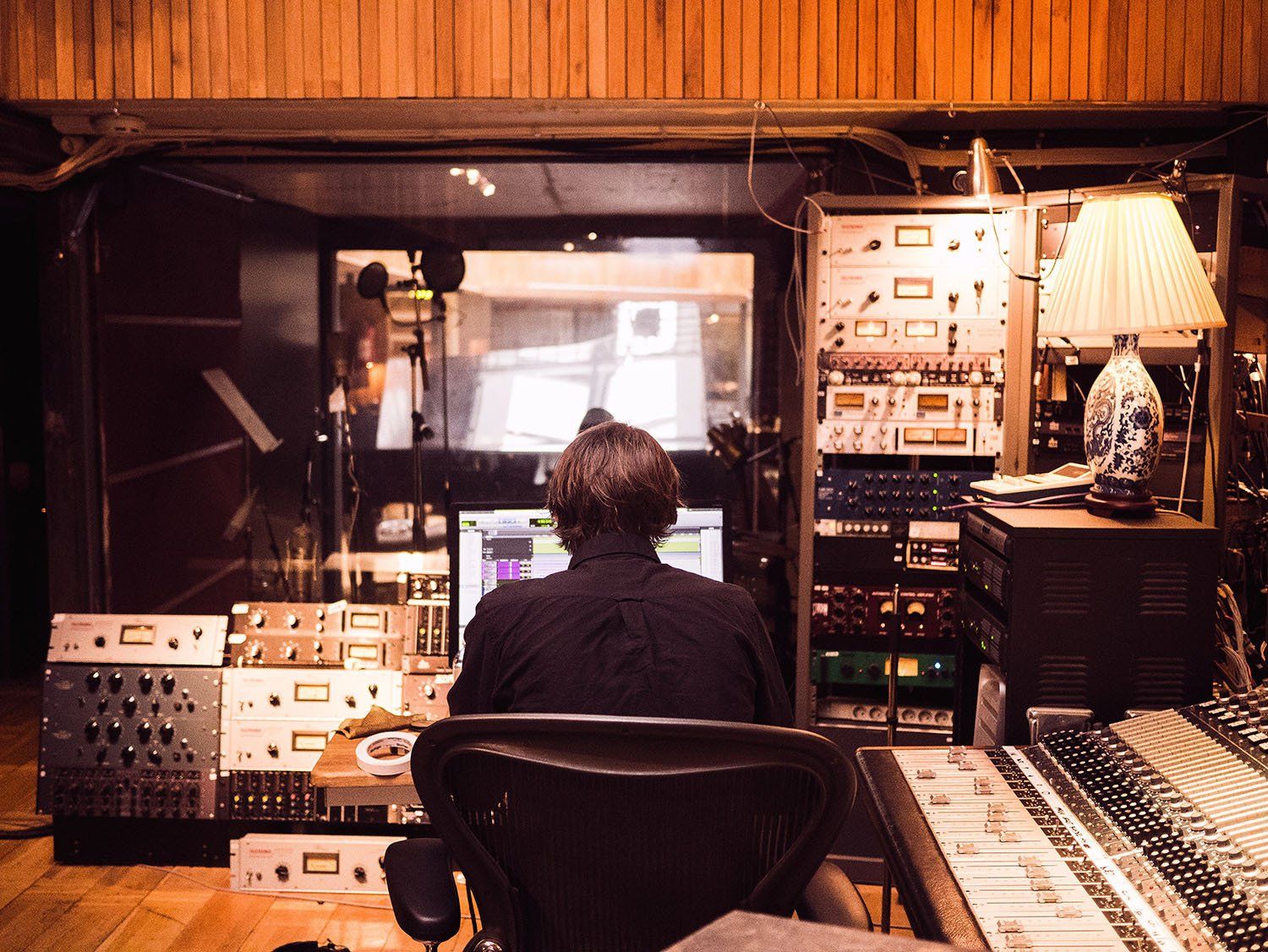
Forget the montage. A working day is closer to project management with very good ears. Some days you're behind the board. Other days you're running cable, ordering lunch, and coaching a singer through one more pass. A producer who can only do the glamorous part of the job is a producer who works far less often.
We broke a full workday down hour by hour in a day in the life of a music producer.
Do You Need to Go to School to Become a Music Producer?
No. And that answer is doing a lot of hidden work, so let's be honest about it.
Self-taught producers are real and plenty of them are excellent. The path works if you have the discipline to structure your own curriculum and the patience to plateau for months with nobody telling you why. The cost is time and uncorrected habits. Bad gain staging and chaotic session files can go unchallenged for years when nobody is checking your work. The harder problem is that when you're starting out you can't reliably tell a working professional from a talented amateur, and YouTube doesn't label the difference.
Formal training from a structured music producer program buys you three things you can't easily get on your own: real gear, real deadlines, and someone experienced telling you what you got wrong while you still remember doing it. The people you train beside, and the industry connections that come with them, come on top of that.
That is where a focused diploma program like OIART’s Audio Recording Technology Program can make a real difference. It is not about needing a credential to be allowed into the industry. It is about building the skills, experience, and connections that help you get there faster.
So the useful question isn't whether to go to an audio recording school. It's which school actually delivers those three things, and how you'd know.
How to Judge a Music Production School
Ask for outcome numbers, and be suspicious when you don't get them.
For music production programs in Ontario, most audio schools will tell you about their gear and their instructors' credits. Far fewer will tell you what share of students finish, and what share are working in audio six months later. Those two numbers tell you more than any studio photo.
You don't have to take any school's word for it. The Government of Ontario publishes this. Career colleges are required to report their key performance indicators to the province, and the results are public. Here is the most recent reporting year:
| School | Graduation Rate | Last Name |
|---|---|---|
| OIART (London) | 92.3% | 80.0% |
| Fanshawe | 69.9% | 35.7% |
| Trebas (Toronto Main) | 65.4% | 60.0% |
| Metalworks | 61.6% | 25.0% |
| RAC (Toronto) | 50.0% | 36.7% |
| Harris (Toronto) | 35.7% | 55.6% |
Source: Career College Key Performance Indicators, 2023 reporting year, Ontario Ministry of Colleges, Universities, Research Excellence and Security. Open Government Licence – Ontario. Employment rate in field of study is measured six months after graduation. Programs compared: OIART – Audio Recording Technology Program. RAC – Sound & Music Recording. Harris Institute – Audio Production Program. Metalworks Institute – Audio Production & Engineering. Trebas – Audio Engineering and Production/DJ Arts. Fanshawe – Music Arts Industry.
Then ask three more questions, and push for specifics.
How many hours are you actually behind gear? Not studio hours the school owns. Hours with your hands on it. How many people are in the room? A class of forty watching one console is a lecture with better scenery. And what happens to the rest of the industry? Music production is one lane. Live sound and audio for visual media have their own hiring pipelines, their own gear and their own busy seasons. A school that trains you for music alone has narrowed your career before you've started it.
If a school can't answer all three quickly, that's an answer too.
Why OIART Answers Those Three Questions Differently
The outcomes hold up, and not because OIART says so. 92.3% graduation and 80.0% employment in the field of study are the strongest results in the provincial comparison above, and they come from the Ontario government's own reporting rather than a brochure.
The hours are the curriculum. The 46-week diploma runs over 1,300 hours, 650 of them hands-on in eight professional studios, in groups of no more than four per studio. Intake is capped at 68 seats, which is small enough that you are behind the board rather than watching someone else be behind it.
You don't have to bet everything on music. This is the part most people miss. If you're searching for music production courses, what you'll find at OIART is broader than that. OIART's Audio Recording Technology Program covers three disciplines at once: music production, live sound and event production, and audio for visual media. Not three streams you choose between. All three, in eleven months, because the audio industry does not hire people who can only do one thing. Graduates walk out able to take a touring gig, a post-production contract or a studio session, which is exactly how working audio careers actually get built.
What Happens After You Finish
Everything above gets you skilled. This is the part that gets you hired.
You leave with credited work from real sessions rather than a folder of practice tracks, because a hiring engineer wants to hear what you have already done, not what you could theoretically do. But the portfolio is only half of it. The other half is that the people who taught you are still working, and they know who is hiring.
That is the piece self-teaching cannot replicate at any price. OIART's instructors are active in the industry, not retired from it, and the Audio Recording Technology curriculum has been built and corrected over four decades by working professionals, guest lecturers and advisors across music production, recording, mixing, live sound, theatre, broadcast, post-production and the music business. Audio changes fast. A curriculum kept honest by people currently doing the work teaches what studios expect this year, not what they expected in 2015.
Then there is who you graduate alongside. More than 1,100 OIART graduates are working across recording, live touring, gaming, broadcast and post-production. Matty Green mixes in Los Angeles with credits including Ed Sheeran, Paul McCartney and Lady Gaga. Matt Andrews runs front of house for Knocked Loose. Michelle Hwu works in game audio at Ubisoft Toronto. Nathan Bond has spent twenty years on monitors and FOH for City and Colour, Our Lady Peace and Alexisonfire. Jason Dufour has a JUNO for Recording Engineer of the Year, and Brennan Mercer has Canadian Screen Awards for Best Sound.
Those are not testimonials. They are people currently holding the jobs you are trying to get, and OIART works directly with the alumni network to put the right graduates in front of the right openings. Assistant engineer and internship roles are still usually the first rung. Having someone on the inside who already knows your work is what makes that first rung shorter.
"I had an amazing experience working with proven audio professionals (the teachers) and other up and coming students to give myself a great skillset. I feel prepared." Mitchell Hamm, OIART graduate
"With such small class sizes and a massive post-graduate network, all of your peers just want to see you succeed." Alex Robillard, OIART graduate
More of them, in their own words, on the graduate testimonials page.
Start Where the Gear Is
There is no single door into this career, but there is a faster one, and it is the one with eight studios behind it. Intake is 68 seats, starting each September.
Book a campus tour and see a session in progress, or check the admission requirements to see where you stand.
Frequently Asked Questions
How do you become a music producer?
There is no licence or degree requirement. You need a trained ear, fluency in a DAW, a working command of signal flow, and a portfolio of real sessions. Most producers build that through some combination of self-teaching and structured training. Training shortens the process by giving you gear, deadlines and corrections you cannot get alone, and it puts you inside a network of working professionals before you graduate.
How long does it take to become a music producer?
There's no fixed timeline. Self-taught producers commonly spend several years finding their footing through trial and error. OIART's Audio Recording Technology Program is an 11-month diploma, 46 weeks, September to July.
Do you need a degree to become a music producer?
No, and no licence or certification either. What studios and artists assess is your portfolio of credited work, your speed in a DAW, and whether you can run a session without creating problems. Required and useful are different things, though. Formal training is how most people build that portfolio faster and with fewer uncorrected habits, and 80.0% of OIART's diploma graduates are working in their field of study six months after finishing.
Can you become a music producer with no experience?
Yes, and almost everyone starts there. The variable is how quickly you get access to real sessions, real gear and real feedback, because that access is what converts practice into a portfolio.
Is music production a good career in Canada?
It can be, particularly for people who can work across more than one audio discipline. Producers who can also take live sound and post-production work have far more of the calendar available to them.
Ready to Start?
OIART's Program Includes:
✓ Small Class Sizes
✓ On Site Facilities
✓ Industry Leading Instructors
✓ Post Grad Support & Guidance
✓ Exclusive 11 Month Program
Top Reasons Why You Should Choose OIART.
Have Questions?
If you have questions about our program for audio engineering and music production or would like to book a tour, we would be pleased to speak with you.
Text Us: 519.200.4151
Share This With a Fellow Music Lover
Apply in 3 Steps!
Step 1: Click Apply Now to start.
Step 2: Answer questions about yourself.
Step 3: Submit and check your email.
Share this with fellow music lovers